Open source · Local first · Repository native

One control plane for your coding models.

AIWorkHub is an open-source multi-model AI coding agent control plane for VS Code and MCP. It does not replace Codex, Claude, Copilot, DeepSeek or GLM—it turns them into one repository-scoped workforce with dependency-aware tasks, durable context, source intelligence and evidence-based review.

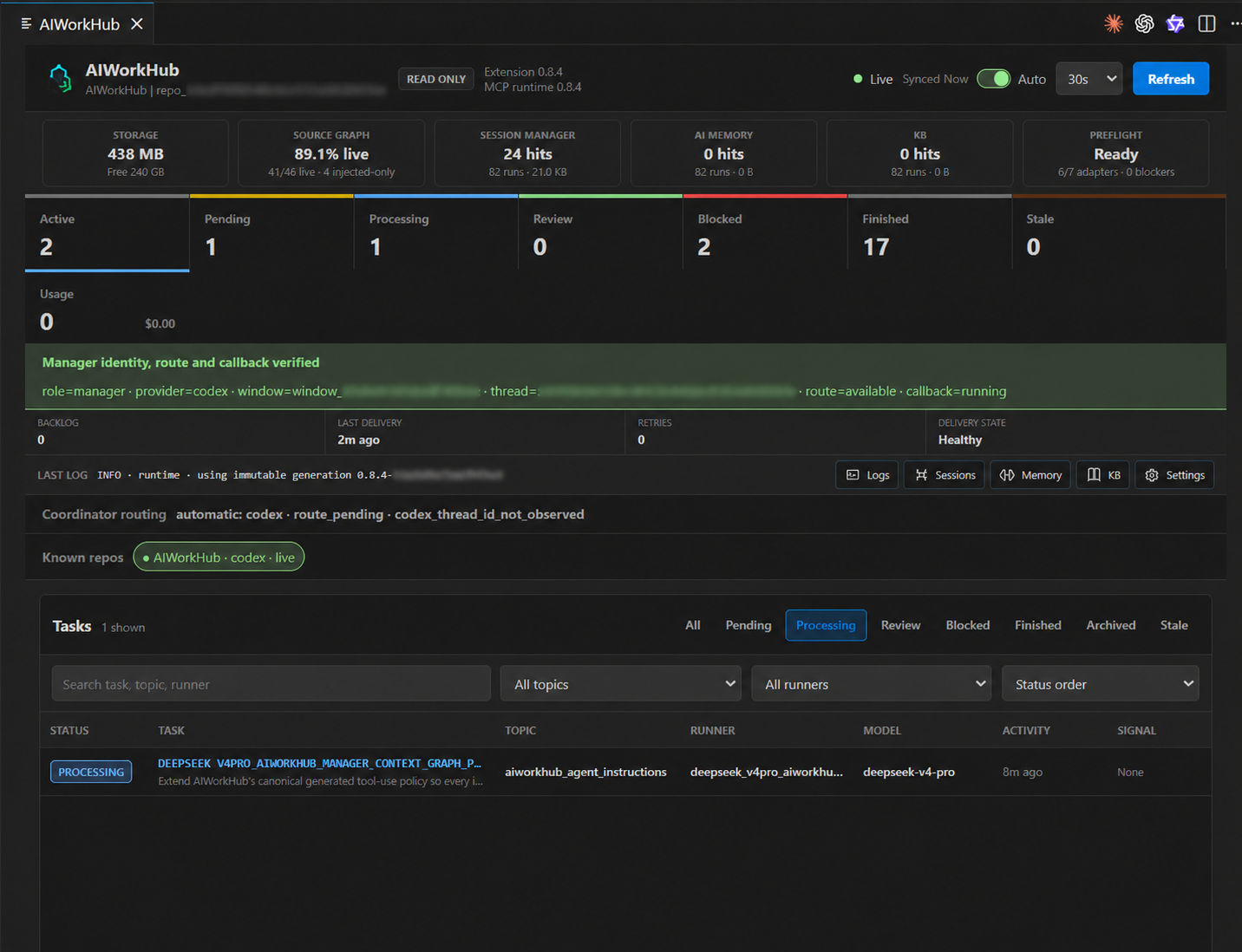
AIWorkHub managing its own repository

AIWorkHub dashboard showing repository tasks, source graph, context stores, preflight and callback health
The engineering loop

Delegate work without giving up authority.

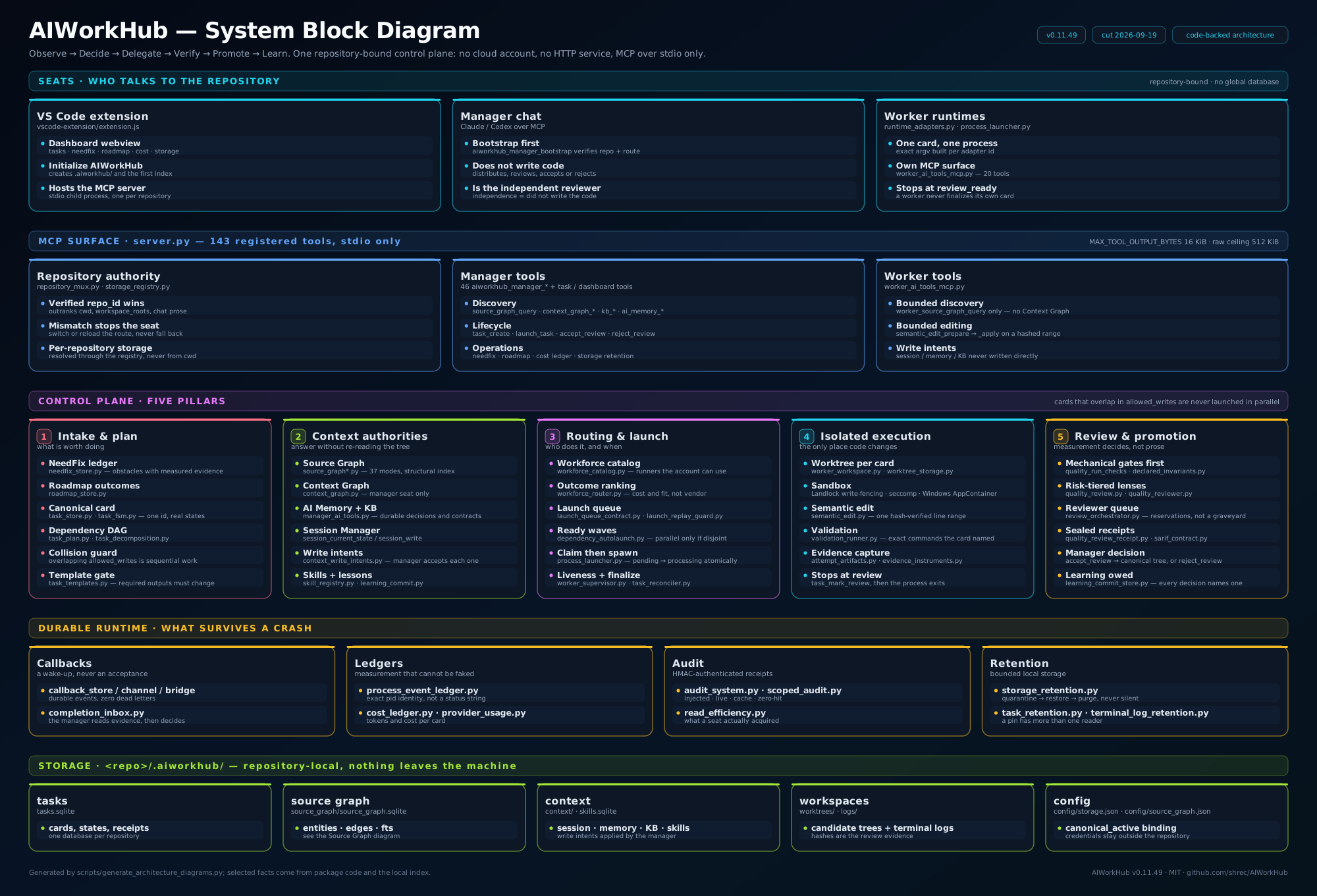
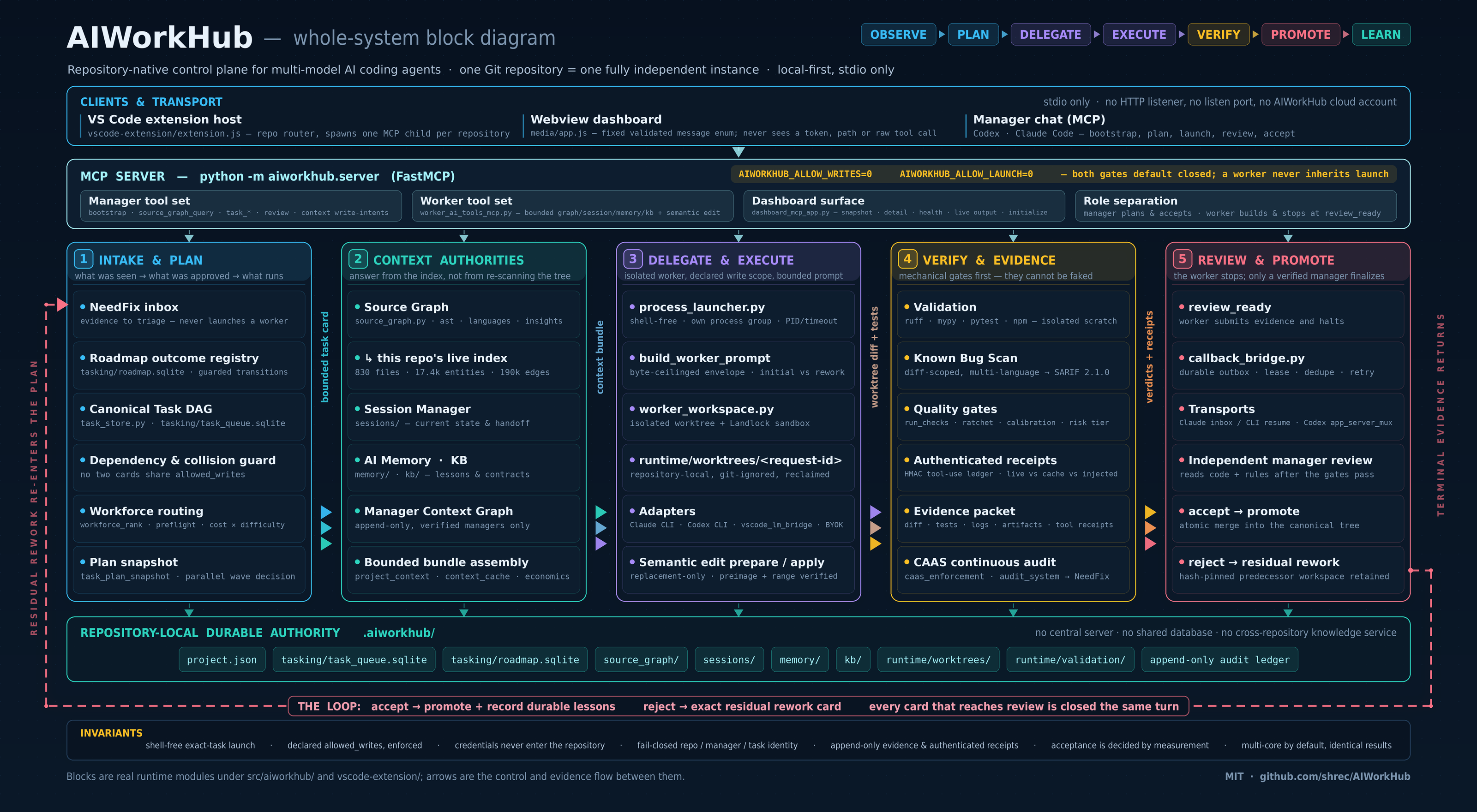
Every repository owns its task state, indexes, memories, callbacks and audit trail. Models work in bounded scopes; the manager accepts changes only after evidence is checked.

Plan a dependency-aware task
Choose an available model route
Work in an isolated scope
Collect diff, tests and receipts
Accept, reject or rework
Built from a real engineering bottleneck

Your coding agents can write code. Who keeps the work coherent?

AIWorkHub began while managing long-running, multi-model development: decisions disappeared after context compaction, repositories were scanned repeatedly, parallel changes collided, session knowledge was lost and a model's “done” still required manual proof.

I did not build AIWorkHub to demonstrate multi-agent orchestration. I built it because I needed several coding models to work on real repositories without losing decisions, colliding with each other or asking me to trust unverified completion claims.

Task DAGs, Source Graph, Manager Context Graph, durable memory, callbacks, isolated workers and evidence receipts are direct answers to those failures—not a collection of unrelated agent-demo features.

Product surfaces

Built for real multi-agent coding workflows.

01

Agent orchestration

Repository-bound tasks, dependency planning, model routing, bounded execution and callback delivery.

02

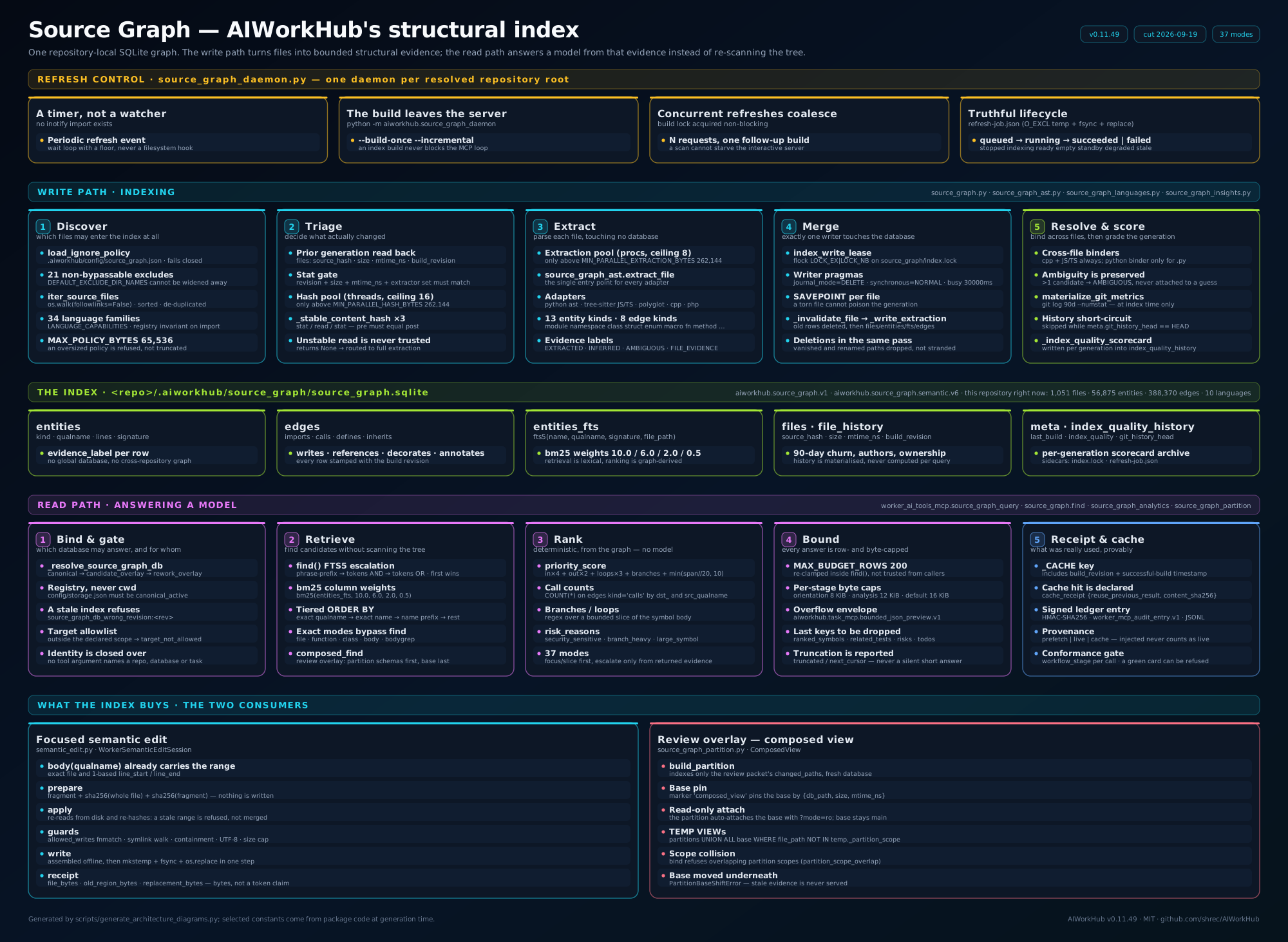
Source Graph

Structural code context through focused, sliced, impact, trace and bundle queries instead of repeated broad scans.

03

Durable context

Separate Session Manager, AI Memory, knowledge base and manager-only Context Graph authorities.

04

Evidence-based review

Review diffs, tests, logs, artifacts, tool-use receipts and approval history—not model self-reports.

05

Multi-agent planning

Parallelize independent cards while dependency and write-scope collision checks preserve task truth.

06

VS Code and Remote SSH

Use the editor models and authenticated CLIs you already have across Windows, macOS, Linux and Remote SSH.

Model portfolio economics

Use frontier models for judgment—not for every unit of work.

AIWorkHub can reserve premium models for architecture, difficult reasoning and independent review while routing bounded research, tests, focused edits and mechanical throughput to lower-cost capable models. Source Graph and semantic edits reduce avoidable tokens on every route; model routing then reduces how many of the remaining tokens are bought from the most expensive model.

LayerSystem actionEconomic effect
Token efficiencyBounded graph context, bounded reads and replacement-only editsLess unnecessary input and code-output payload
Model-mix efficiencyMatch task difficulty to capability, readiness, observed quality and known costFewer premium-model tokens for work an economical route can complete
Attempt efficiencyPreserve exact failure evidence and issue bounded residual reworkFewer blind retries and less repeated context/work
Deterministic offloadApply hash-bound edits and run validation locallyNo model spend for operations that do not require model judgment

The mechanism is shipped; the public system-wide ROI is not yet claimed. In the measured Claude cohort, Opus used 19% of tokens but 42.9% of known cost. AIWorkHub counts routing as a saving only after the cheaper route preserves validation and manager-accepted quality.

The product category

Control plane above the agents you already use.

AIWorkHub does not compete with the models whose work it coordinates. Its real alternative is manual multi-chat orchestration or a custom stack of task boards, worktrees, context stores, scripts and review glue.

LayerExamplesRole
Repository control planeAIWorkHubTask authority, routing, context, isolation, evidence, callbacks, review and economics
Supported workforceCodex, Claude, Copilot-hosted models, DeepSeek, GLMExecution routes coordinated by AIWorkHub—not competitors
Adjacent context/edit toolsGraphify, Serena and similar toolkitsComplementary graph, retrieval or semantic capabilities
Standalone agent clientsAider, Cline and similar productsAlternative execution experiences, not the same control-plane layer
Actual alternativeManual coordination or custom in-house glueCopy/paste context, hand-managed worktrees, retries and review state
System evidence

Measure benefits, failures and unknowns.

AIWorkHub distinguishes structural bytes, provider tokens, task outcomes, manager decisions, callback durability and missing evidence. The full benchmark matrix publishes favorable and negative results with their exact populations.

7/7current gated tasks used live Source Graph evidence
Not claim-eligiblehistorical capped A/B observation; pair 1 used mismatched 20k/200k token ceilings
0dead letters across 271 callback events
−29.329%same-evidence v2 context-envelope fixture versus legacy v1

The historical capped A/B observation recorded 27.5% fewer total tokens, but pair 1 used mismatched 20k/200k token ceilings. It is not eligible for a causal or product-savings claim; an uncapped matched rerun is required. The envelope result is deterministic structural evidence from one same-evidence fixture; the old 0.8.81 fleet expanded 20.0% and v2 still needs an equivalent live remeasurement. Tool-use outcome differences are observational, and system-wide cost savings remain unmeasured.